Furniture shifting today looks quite different from what it looked like twenty or thirty years ago. Improvements in packing materials have reduced damage rates, given furniture better protection during transit, and made the overall process safer and more reliable. This evolution is worth understanding because it explains why professional packing is meaningfully better than improvised approaches.
From Old Newspapers to Bubble Wrap and Foam
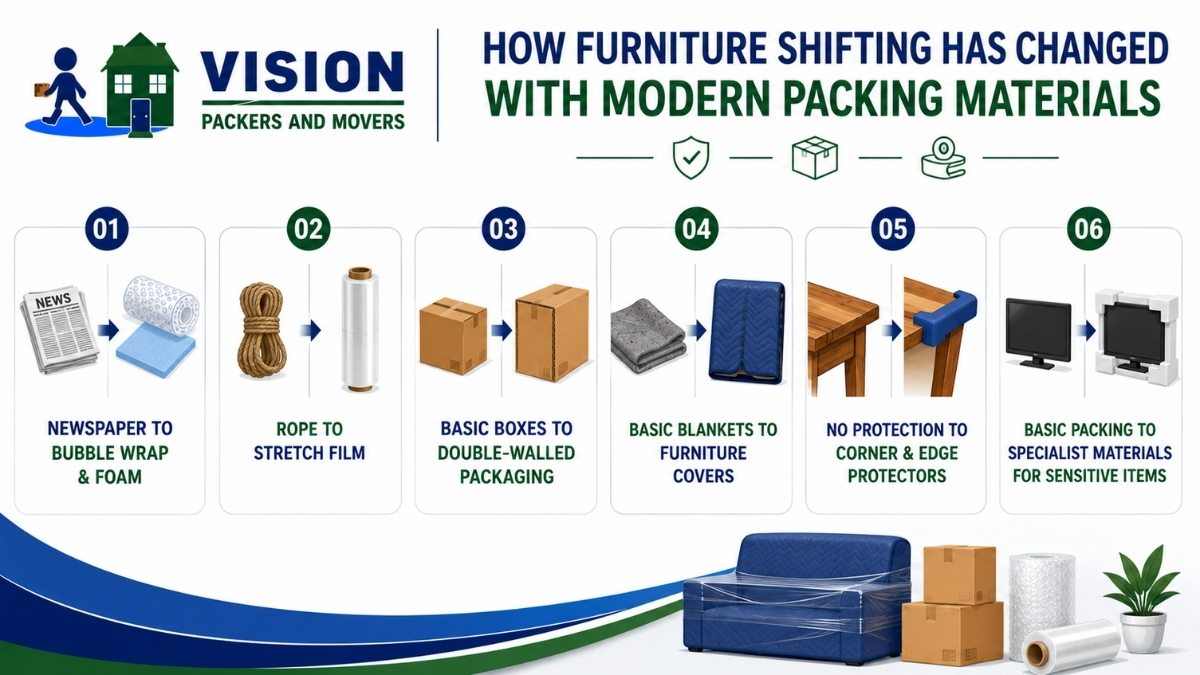
Older moving methods relied on layers of newspaper to wrap fragile and finished surfaces. Newspaper is thin, it tears easily, and the ink can transfer to light-coloured furniture or painted surfaces. Modern bubble wrap provides a cushioning layer that absorbs impact rather than just covering a surface.
Closed-cell foam sheets add a non-scratch surface between the wrapping material and the furniture finish. These two materials together provide protection that newspaper simply cannot match. For wooden furniture with a polished or lacquered surface, even a single layer of foam sheet prevents the micro-scratches that contact with newspaper creates.
From Rope to Stretch Film
Tying furniture with rope was the traditional method of securing bundles for transport. Rope concentrates pressure on the surface at the tie point and can leave indentations on wood or marks on fabric over a long journey. Modern stretch film wraps the entire surface of a piece uniformly, holding protective padding in place without any single point of pressure.
Stretch film is also faster to apply and easier to remove at the destination. It leaves no residue on most surfaces and does not require the skill that tying secure knots in the right positions demands. This speed and ease has made it the standard tool for furniture wrapping in professional moving.
From Basic Boxes to Corrugated and Double-Walled Packaging
Older moving practice used whatever boxes were available — often single-layer cardboard from a local shop, which softens quickly under weight or when damp. Modern moving uses corrugated double-walled boxes that maintain their structure under significant weight and resist moisture far better than single-layer alternatives.
For high-value electronics and fragile items, custom-cut foam inserts provide a shaped interior that holds the item firmly in place during transit. These inserts prevent the internal movement that causes damage when a box is tilted or receives an impact from outside.
Specialised Furniture Covers
One of the more significant recent developments is the availability of purpose-made furniture moving blankets and covers. These are thick, quilted pads designed to wrap around sofas, tables, wardrobes, and mattresses during transit. They prevent surface scratches without adhesive, can be reused, and are significantly more protective than an old sheet or blanket.
Professional moving companies invest in these covers as part of their standard equipment. Their presence is often a reliable indicator of how seriously a company takes damage prevention. A company that uses purpose-made furniture covers treats every item it handles as if it has value worth protecting.
Corner and Edge Protectors
The corners and edges of furniture are the parts most likely to be chipped or dented during a move. Modern foam or cardboard edge protectors are specifically shaped to wrap around corners and protect them during the moments of highest risk — passing through a narrow doorway or being set down on the vehicle floor.
This simple addition has reduced chip damage significantly compared to older methods where corners received no specific protection. For furniture with painted or veneered edges, corner protection is the difference between arriving unmarked and arriving with a visible chip at each corner.
Anti-Static and Acid-Free Materials for Electronics and Artwork
For sensitive items, modern packing includes materials that older methods did not consider. Anti-static bubble wrap prevents static damage to electronics during transit and storage. Acid-free tissue paper protects artwork and photographs from long-term degradation when stored or transported over extended periods.
These materials are used by professional movers handling valuable or delicate items. Their availability and relatively low cost have made high-quality packing of sensitive goods accessible to a much wider range of customers than was the case under older moving practice.
The improvement in packing materials over the past two decades has not happened by accident. It reflects a growing understanding of exactly which moments and surfaces are most vulnerable during a move. The result is a professional moving process that causes significantly less damage than the improvised methods that preceded it.
