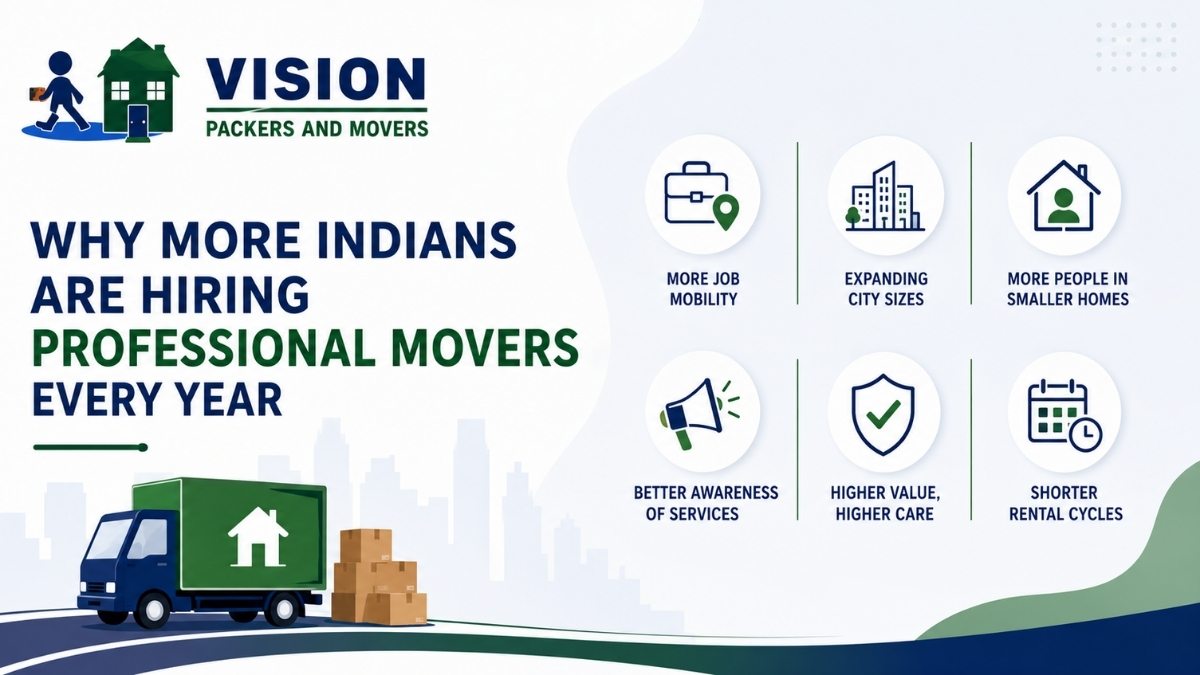
The demand for professional packers and movers services in India has grown noticeably over the past decade. A combination of lifestyle shifts, urban growth, and changing attitudes toward professional help has driven this change. Understanding why helps both first-time movers and repeat customers make more confident decisions.
More People Are Moving for Work
The job market in India increasingly requires people to relocate across cities. A professional hired in Delhi may find a better opportunity in Pune, and a family settled in Chennai may move to Bengaluru following a career change for one member of the family. This internal migration for employment is one of the clearest drivers of demand for professional moving services.
It is not only private sector employees who relocate. Government transfers, defence postings, and public sector assignments have always involved significant movement across the country. As the total volume of people in mobile careers grows, so does the number of households that need professional moving help each year.
City Sizes Are Growing, Shifting Distance Is Increasing
As cities expand outward, even a move within the same metropolitan area can cover forty or fifty kilometres. This scale makes self-shifting — borrowing a vehicle from a friend and completing everything in a single day — impractical. Professional transport handles the scale that personal arrangements cannot.
In the largest cities, urban sprawl has pushed residential areas far from commercial and employment centres. A family moving from a peripheral neighbourhood to a more central one in the same city may cover a distance that would have been a city-to-city journey a generation ago.
More People Are Living Alone or in Smaller Units
The rise of single-person households and nuclear families means more moves happen with fewer people available to help. A family of six can manage a self-shift reasonably well. A person living alone cannot carry a sofa down three flights of stairs without professional help.
As more young professionals move to cities for work without extended family nearby, the available pool of helpers for a self-organised move shrinks. Hiring professionals fills the gap that family networks once covered.
Awareness of Professional Services Has Improved
A decade ago, many people were unaware that a professional packing and moving service existed for household shifting. Online search, word of mouth, and digital platforms have made these services visible and accessible. A first-time mover in a Tier 2 city today is more likely to find and book a professional service than they would have been five years ago.
Better awareness also means better understanding of what the service includes. People now know that professional movers handle packing, loading, transport, and unloading as a single service, which removes the uncertainty that once made people default to self-shifting.
The Cost of Getting It Wrong Has Become Clearer
As the value of household goods increases — more electronics, better furniture, appliances that cost significant amounts — the financial risk of a damaged item during an amateur move becomes harder to accept. Professional movers with transit insurance offer a level of protection that a self-arranged move cannot.
Many households have experienced a broken television or a damaged wardrobe during a self-shift. The experience of paying to repair or replace something because the packing was not done properly tends to change the decision for the next move.
Rental Cycles Are Shorter
Many urban renters move every one or two years as rental agreements end, jobs change, or better accommodation becomes available. This frequency makes professional moving a recurring need rather than a once-in-a-decade event.
For someone who moves regularly, building a relationship with a reliable professional mover makes practical sense. The time saved on each move and the reduced risk of damage justify the cost more clearly than they do for a household that moves once in twenty years.
The shift toward professional moving services is not simply a result of people becoming wealthier or more comfortable spending money. It is driven by real changes in how people live and work across India. The services have become more accessible, more visible, and more useful to a wider range of households than ever before.
